Break it into pieces.
A custom byte-pair tokenizer uses the first 8,192 mergeable entries from o200k_base, with its original pretokenization rules. All 256 single-byte values are covered.
8,192 original glyphs. A real tokenizer.
A reversible way to write something alien.
Write anything. Each token becomes its own glyph.
Words can split into smaller pieces; spaces and punctuation count, too.
Stepped corners, open shapes, and branching strokes.
Select a character to inspect its token, bytes, and vector.
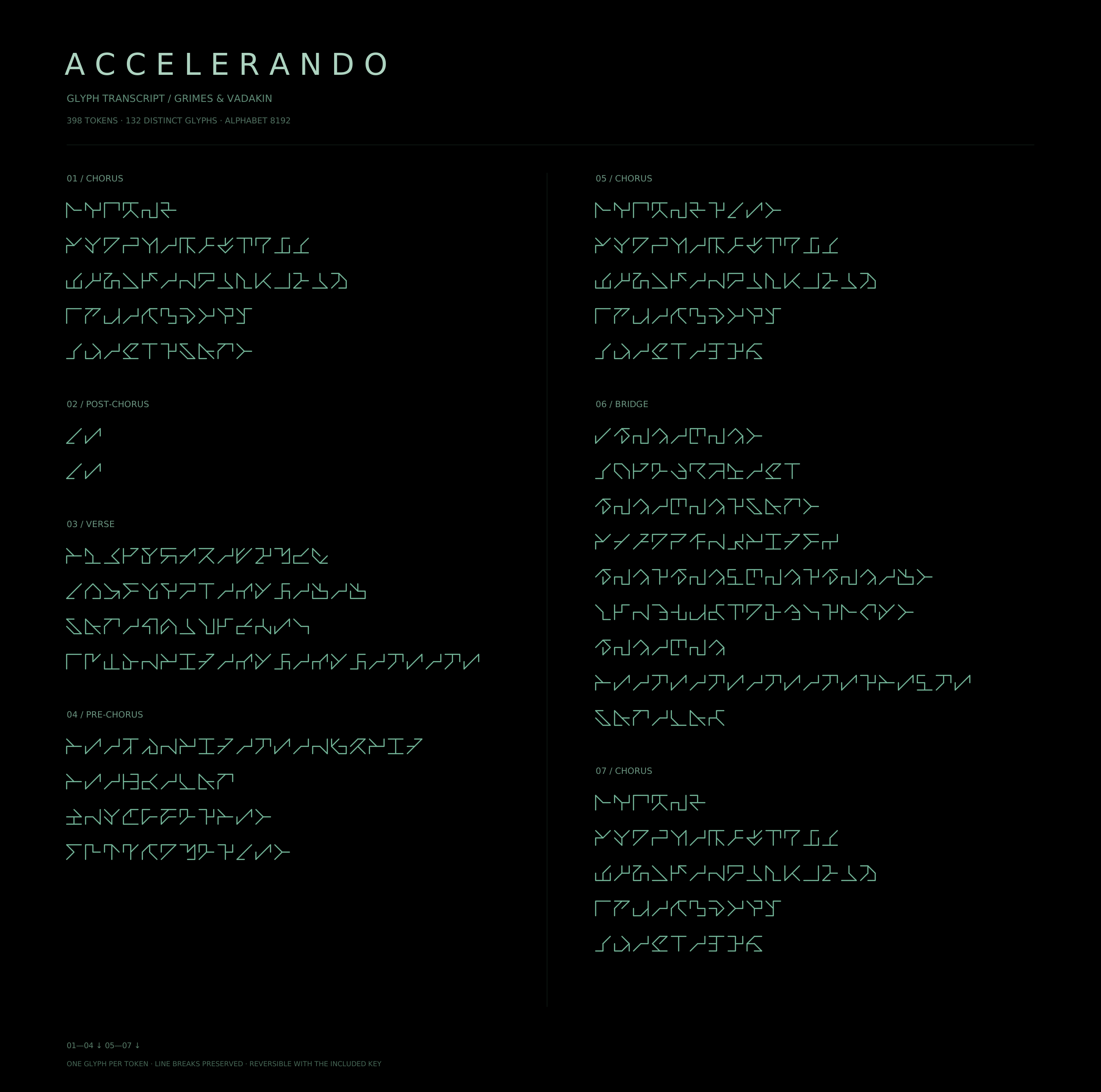
Grimes & Vadakin, written in the glyph alphabet.
34 lines. 398 tokens. 132 distinct characters.
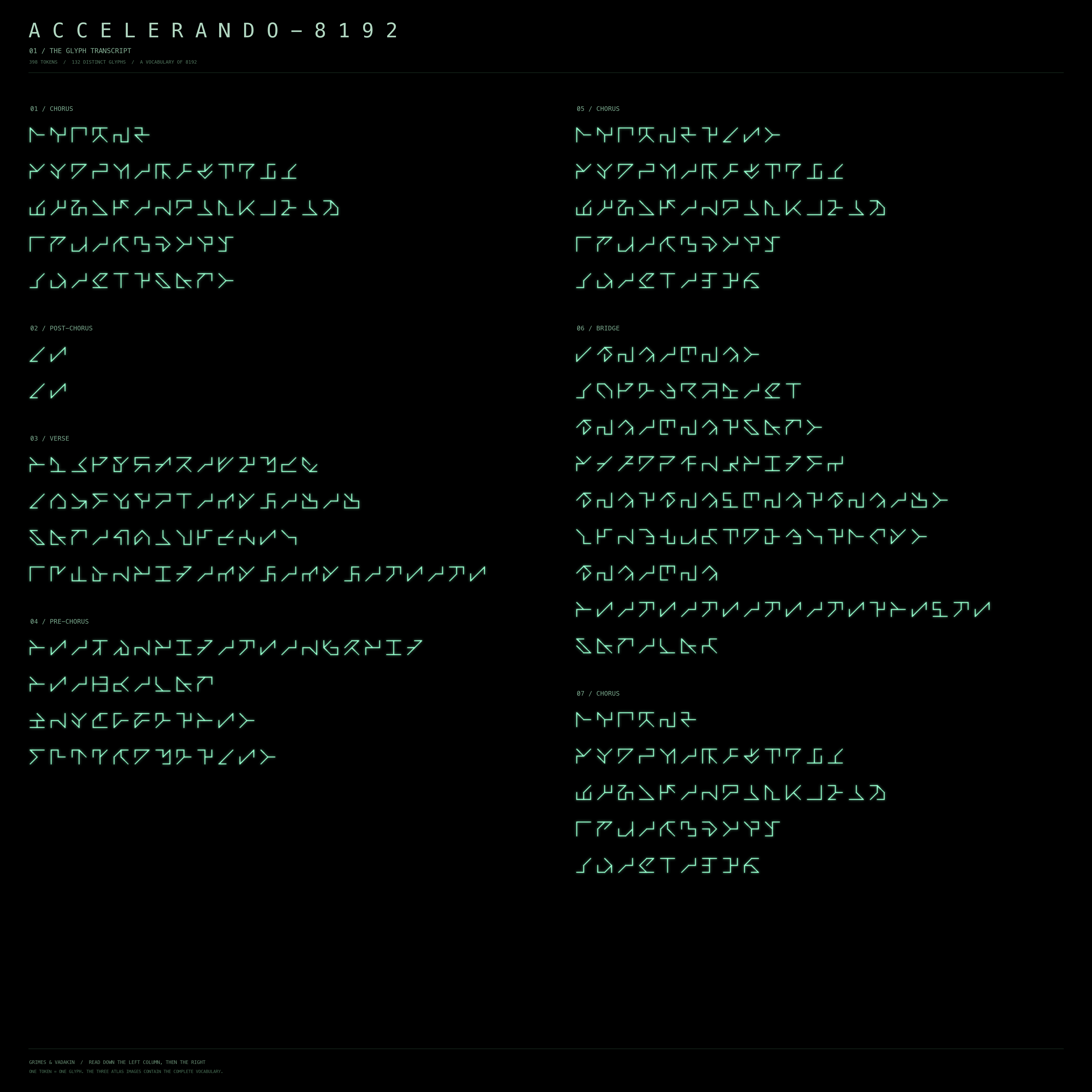 01 / THE SONG EXPAND ↗
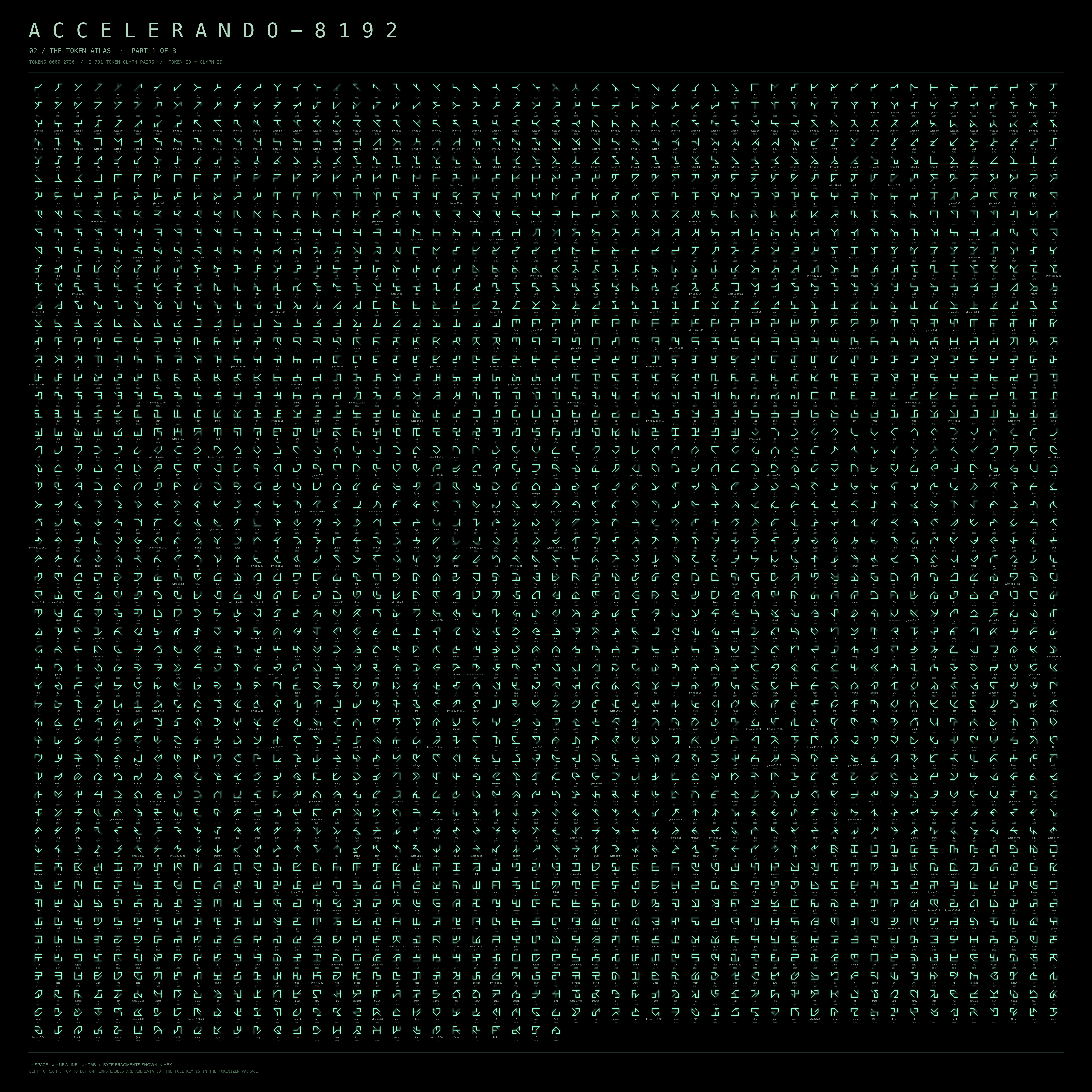
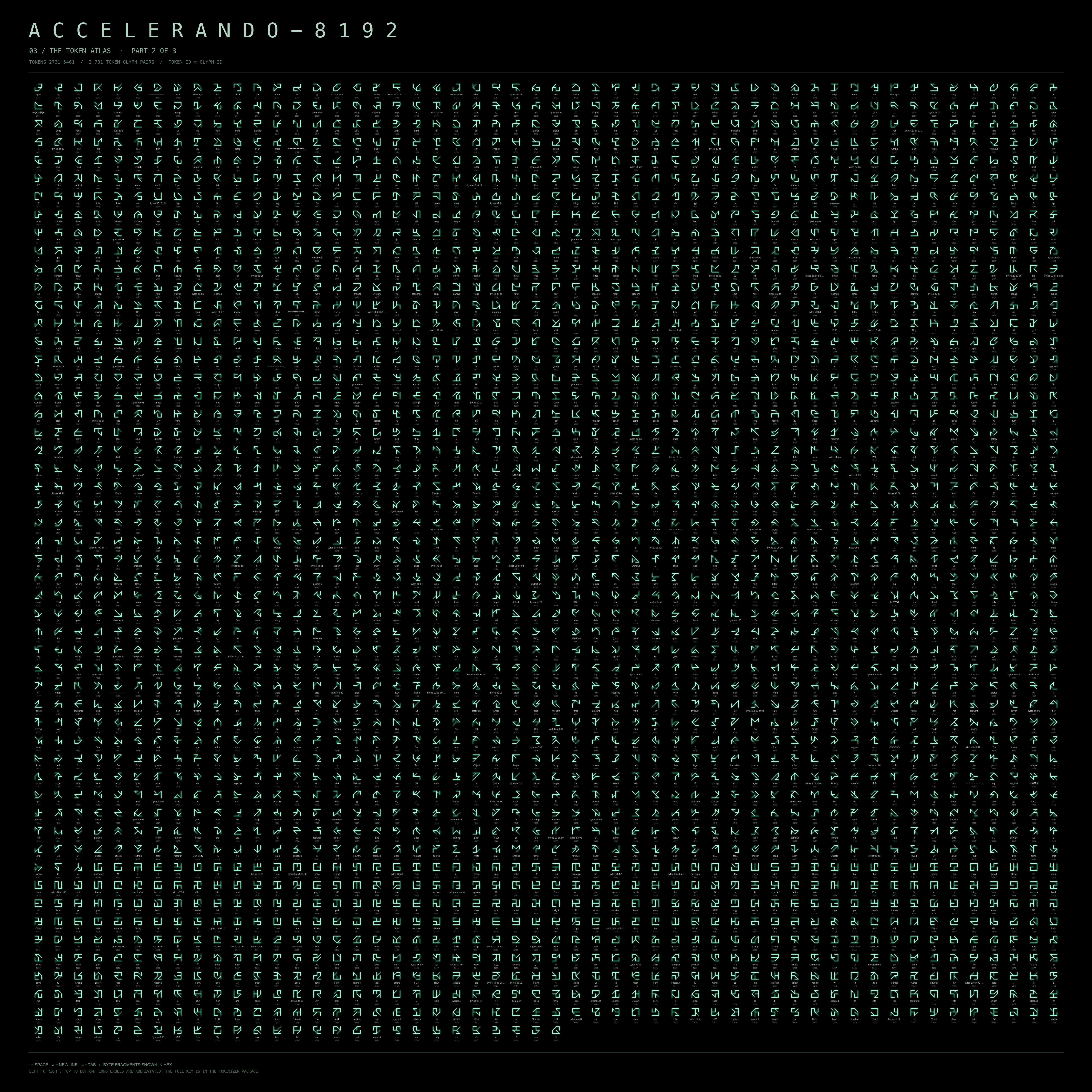
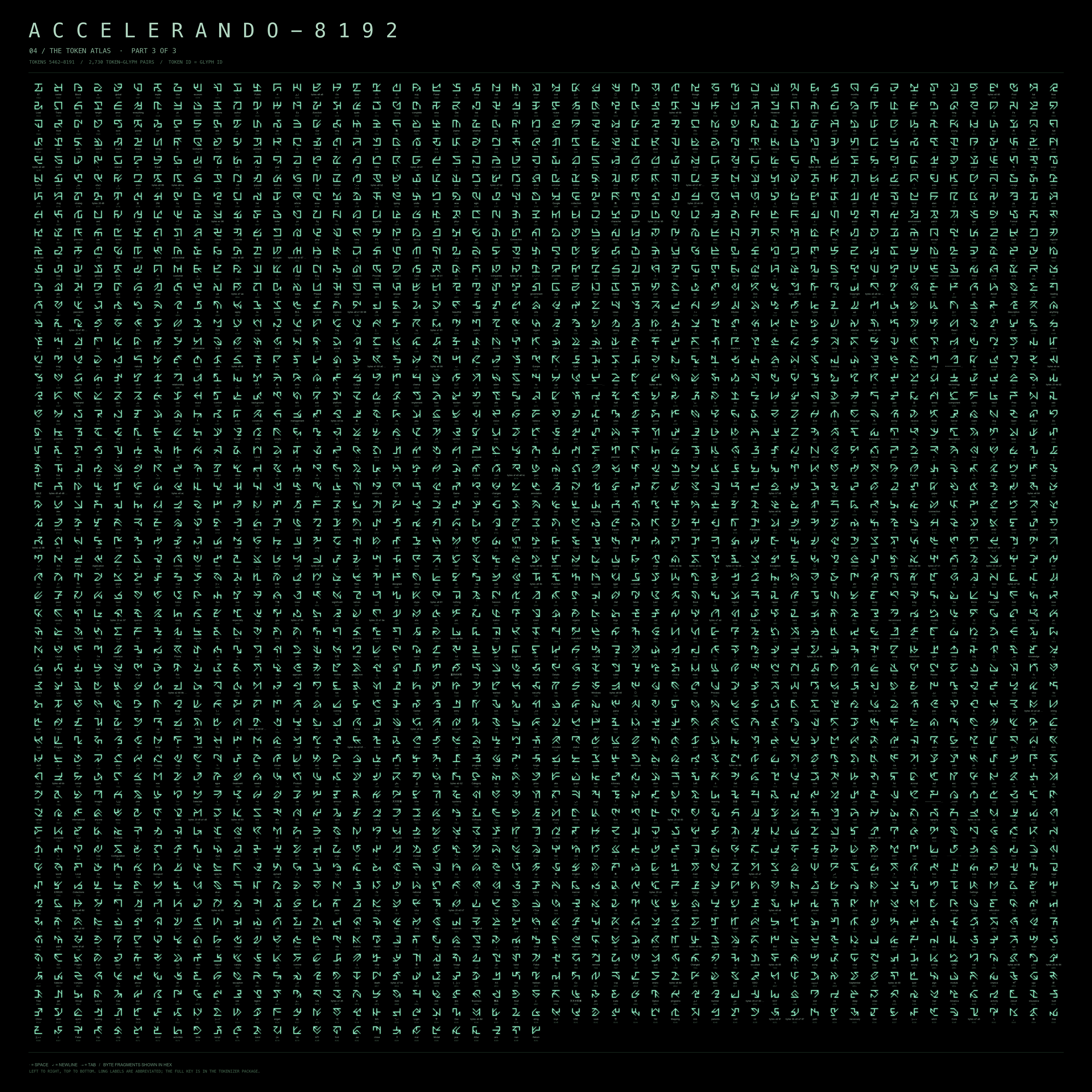
The song uses a fraction of the alphabet. Three companion plates contain all 8,192 token–glyph pairs, exactly once.
Download all four images ↓Four 6144 × 6144 PNGs. Each under 5 MB.Not a translation, and not an embedding model. Accelerando-8192 changes how text is represented while keeping the original bytes intact.
A custom byte-pair tokenizer uses the first 8,192 mergeable entries from o200k_base, with its original pretokenization rules. All 256 single-byte values are covered.
Token ID equals glyph ID. Character 500 always represents token 500, in every message. The full vocabulary exists independently of any song or sentence.
Each glyph is a distinct connected shape on a compact grid. Horizontal, vertical, and 45-degree strokes preserve the alphabet’s angular character.
Use the font, inspect the vocabulary, or build your own experiment. Everything needed to reproduce the encoding is here.
Font, tokenizer, full atlas, song transcript, and Python encoder / decoder
The song and three atlas plates, in upload order
All 8,192 pairs in one infinitely scalable sheet
Installable font · Unicode private-use range U+F0000–U+F1FFF
Every token’s exact bytes and matching glyph ID
8,192 transparent SVG files for design, print, and your own projects
The complete glyph transcript as a scalable vector artwork